Tell us about the job
Takes about a minute. No obligation.
Sizing a furnace for this address starts with understanding what the equipment is actually being asked to carry. Homes in New York County, NY run heat about seven months a year, from October through April. The burner and heat exchanger cycle through that entire stretch, and an undersized or poorly sealed installation cannot hide that load the way it might somewhere the system sits idle most of the year. A contractor quoting a replacement here will want a proper load calculation, because the consequences of getting it wrong show up in cracked exchangers and ignition failures that arrive well before the system's expected end of life.
Ductwork laid when these buildings first went up was designed around the equipment of that moment, and every system that replaced it since has had to work within those original paths. Half the homes in New York County, New York were built in 1951 or earlier (2020-2024 ACS 5-year). That history means a contractor evaluating a furnace installation here has to open and measure the distribution system before anything else, because a duct that moved enough air for one generation of equipment may not move enough for what runs now. The electrical side carries the same question: original service panels were not sized for current draw, and whether the existing supply is adequate is something a contractor has to verify at the panel, not from the spec sheet.
What Gets Installed With a New Furnace
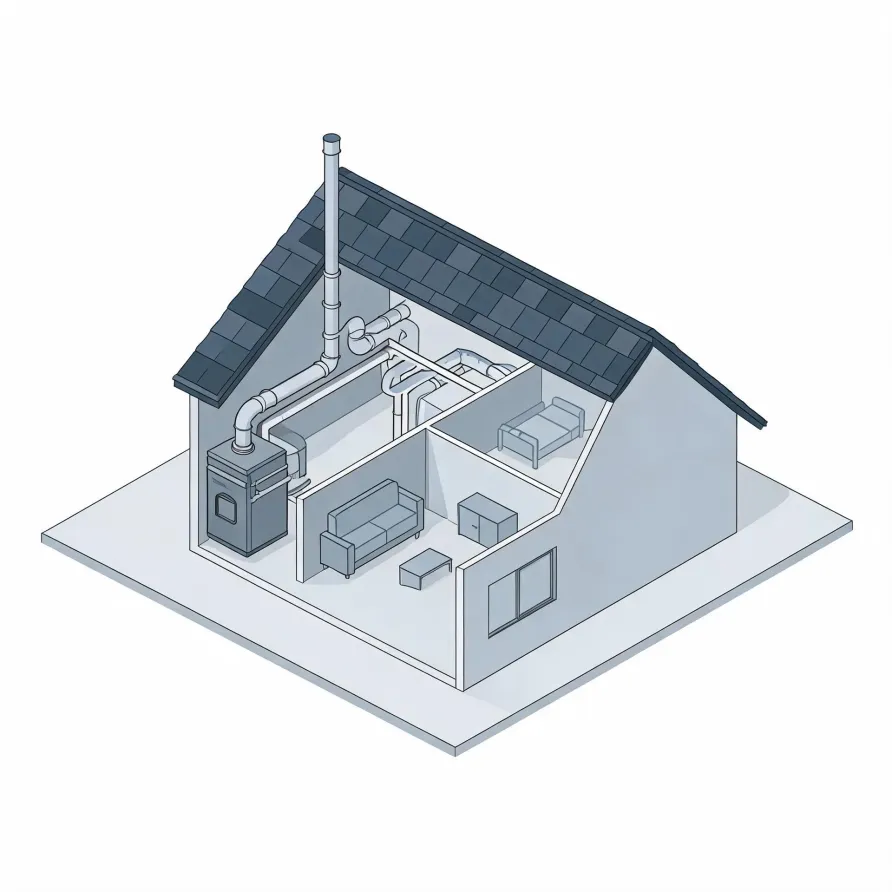
The furnace itself sits in the basement, utility room, or closet and is the heart of what a contractor puts in. Attached to it is the heat exchanger, a metal chamber where combustion heat passes into the air supply. The burner assembly and blower motor live inside the cabinet as well, the burner producing the heat and the blower pushing conditioned air out through the house.
The flue pipe runs from the furnace up and out of the house, carrying exhaust gases safely away. A new thermostat or control board ties into the system at the same time, giving the furnace something to respond to. The contractor also fits the gas line connection and any supply and return plenums where the furnace meets the duct openings.
The drawing shows a typical layout, and a licensed contractor determines exactly what applies to your house and its existing setup.
Get matched in New York CountyNew York County, by the numbers
52 severe weather events were recorded in New York County, New York between 2015 and 2024.
NOAA National Centers for Environmental Information, Storm Events Database, bulk CSV export, events 2015-01-01 through 2024-12-31.Half the homes in New York County, New York were built in 1951 or earlier (2020-2024 ACS 5-year).
U.S. Census Bureau, 2020-2024 American Community Survey 5-Year EstimatesNew York County, New York holds 923,472 housing units (2020-2024 ACS 5-year).
U.S. Census Bureau, 2020-2024 American Community Survey 5-Year EstimatesOwners occupy 25.1% of the occupied homes in New York County, New York (2020-2024 ACS 5-year).
U.S. Census Bureau, 2020-2024 American Community Survey 5-Year EstimatesFurnace Installation Rules for New York County, New York4 sourced standards and codes
What the installation looks like
Non-weatherized gas furnaces manufactured on or after November 19, 2015 must reach 80.0 percent AFUE.
Non-weatherized oil-fired furnaces manufactured on or after November 19, 2015 must reach 83.0 percent AFUE.
Mobile home gas furnaces manufactured on or after November 19, 2015 must reach 80.0 percent AFUE.
Non-weatherized gas furnaces manufactured on or after December 18, 2028 must reach 95.0 percent AFUE, up from the 80.0 percent minimum that applies to units manufactured before that date.
Severe Weather Events in New York County
New York County's weather puts real demands on heating equipment, from hard winters that run furnaces at full load to the temperature swings that stress components over time. How often those demands spike is a local fact, and it shapes what a furnace installation here needs to handle.
52 severe weather events, 2015–2024. Source: NOAA National Centers for Environmental Information, Storm Events Database.