Tell us about the job
Takes about a minute. No obligation.
Sizing a furnace for a Clinton County home is not a calculation a contractor can do from catalog sheets alone. Homes in Clinton County, NY run heat about nine months a year, from September through May. The burner, the heat exchanger, and the ignition system cycle through nearly the full calendar year, which means a unit that is undersized runs longer at higher strain, and one that is oversized short-cycles through a season with almost no idle time to hide the consequences. A contractor working a quote here has to establish the actual heat load of the house before committing to equipment, because the install has little room to self-correct once the cold sets in.
Ductwork laid down for an earlier generation of heating equipment carries assumptions about airflow, trunk sizing, and branch runs that a new furnace may not share. Half the homes in Clinton County, New York were built in 1974 or earlier (2020-2024 ACS 5-year). A contractor pricing a furnace installation here measures what is already in the walls before the new unit ever comes up in conversation, because ductwork that cannot move the air a modern system pushes will undercut the installation regardless of what the equipment itself can do. The electrical service gets the same look, since the load a current furnace draws has to land somewhere on a panel that was not designed around it.
What Gets Installed With a New Furnace
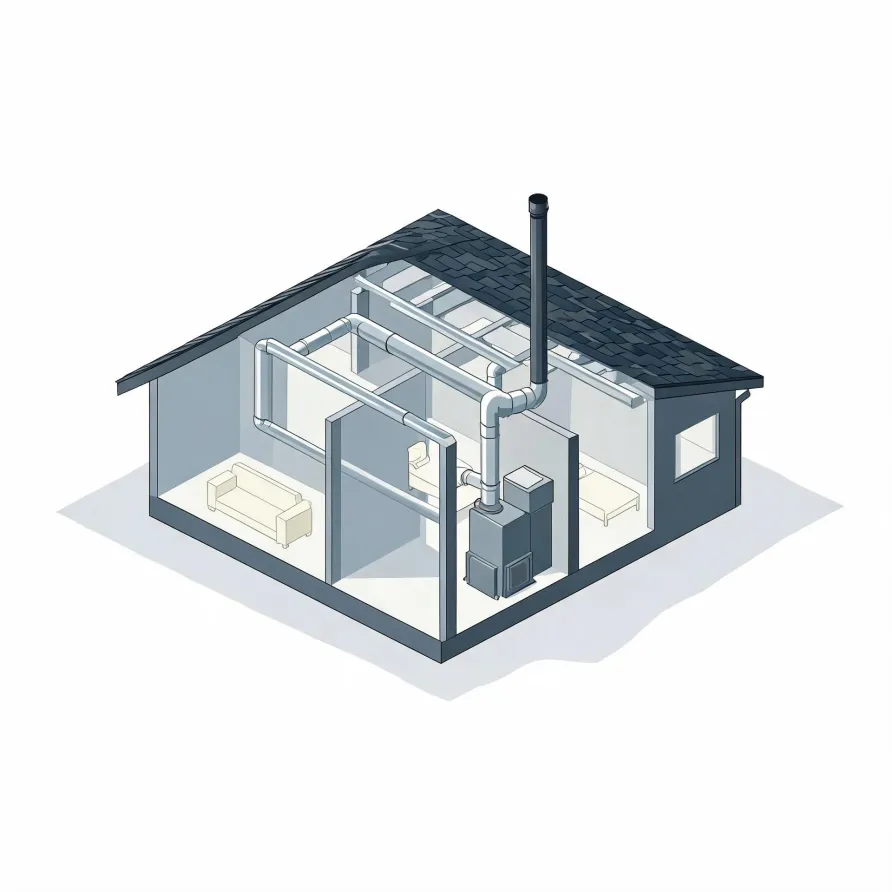
The furnace itself sits in the basement, utility room, or crawl space and is the piece doing the heavy lifting. A contractor mounts the unit there, connects it to the gas supply line, and ties it into the home's existing duct openings. The flue pipe runs from the furnace up and out of the house, carrying combustion gases away.
The thermostat goes on an interior wall, usually in a main living area, and is the control point the household uses every day. Alongside it, a contractor installs or replaces the air handler components that move conditioned air through the ducts, and fits a new filter housing where the return air enters the system.
The drawing shows a typical layout, and a licensed contractor determines exactly what applies to your house.
Get matched in Clinton CountyClinton County, by the numbers
133 severe weather events were recorded in Clinton County, New York between 2015 and 2024.
NOAA National Centers for Environmental Information, Storm Events Database, bulk CSV export, events 2015-01-01 through 2024-12-31.Half the homes in Clinton County, New York were built in 1974 or earlier (2020-2024 ACS 5-year).
U.S. Census Bureau, 2020-2024 American Community Survey 5-Year EstimatesClinton County, New York holds 37,658 housing units (2020-2024 ACS 5-year).
U.S. Census Bureau, 2020-2024 American Community Survey 5-Year EstimatesOwners occupy 69.4% of the occupied homes in Clinton County, New York (2020-2024 ACS 5-year).
U.S. Census Bureau, 2020-2024 American Community Survey 5-Year EstimatesFurnace Installation Rules for Clinton County, New York4 codes, standards, and laws
What the installation looks like in Clinton County
Non-weatherized gas furnaces manufactured on or after November 19, 2015 must reach 80.0 percent AFUE.
Non-weatherized oil-fired furnaces manufactured on or after November 19, 2015 must reach 83.0 percent AFUE.
Mobile home gas furnaces manufactured on or after November 19, 2015 must reach 80.0 percent AFUE.
Non-weatherized gas furnaces manufactured on or after December 18, 2028 must reach 95.0 percent AFUE, up from the 80.0 percent minimum that applies to units manufactured before that date.
Severe Weather Events in Clinton County
Local weather puts a measurable load on heating equipment over its lifetime. A furnace sized and installed for what Clinton County actually delivers performs differently than one built to a regional average.
133 severe weather events, 2015–2024. Source: NOAA National Centers for Environmental Information, Storm Events Database.