Tell us about the job
Takes about a minute. No obligation.
A furnace repair in Cayuga County starts with the ignition system and the heat exchanger because those are the parts that cycle every time the burner fires. Homes in Cayuga County, NY run heat about eight months a year, from October through May. That kind of runtime loads the igniter, the flame sensor, and the heat exchanger with far more cycles than the calendar months suggest, since each of those components responds to every call for heat, not just to the season as a whole. A contractor who skips straight to the control board or the blower motor without checking ignition components first is working against the wear pattern the equipment here actually shows.
Ductwork in this county's older homes was often laid out around heating systems that have since been replaced more than once, and each substitution leaves the next contractor reading what previous ones left behind. Half the homes in Cayuga County, New York were built in 1958 or earlier (2020-2024 ACS 5-year). When a furnace opens up in stock like this, what a contractor finds inside frequently reflects that layered history: components stressed in ways the original installation never anticipated, and replacement parts that take real sourcing effort because the equipment has aged past what distributors keep on the shelf.
The Parts of a Furnace a Contractor Checks First
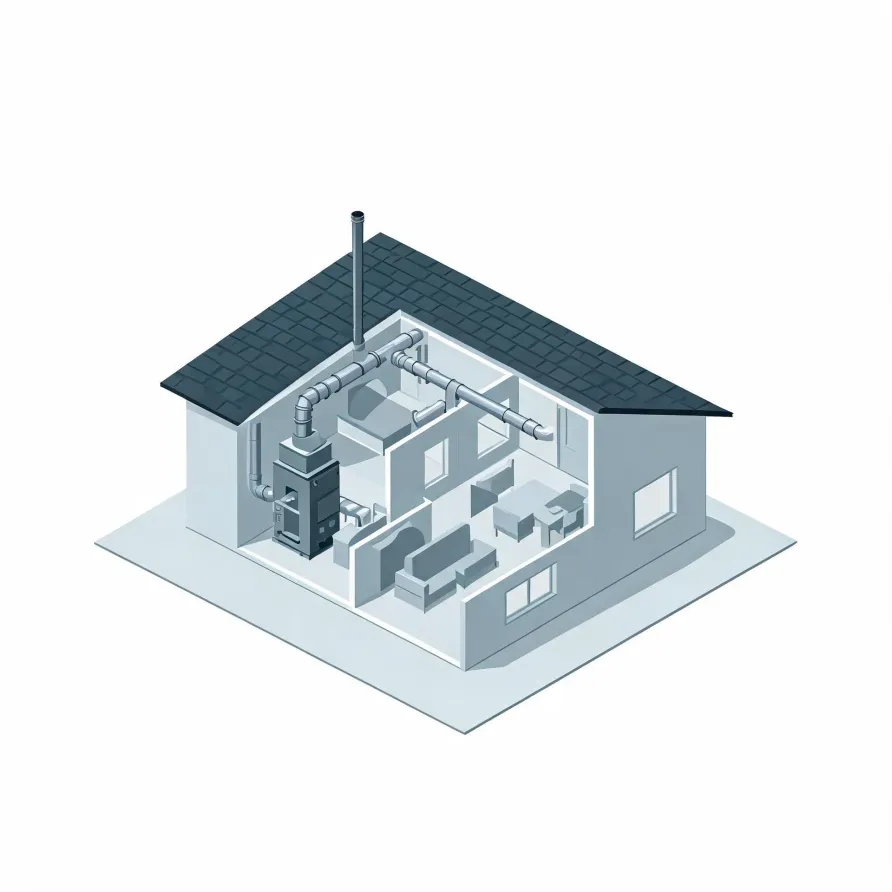
The heat exchanger sits at the core of the furnace cabinet in the basement or utility closet, and it is the piece a contractor looks at closely when a furnace is producing no heat or the wrong amount. The burner assembly sits just below it, and a fault there shows up as ignition failure or an uneven flame.
The blower motor and its fan wheel push conditioned air out through the supply side of the system. The control board sits in the lower cabinet panel and coordinates every other component. When a furnace behaves erratically, a contractor reads the board's fault codes before touching anything else.
The drawing shows a typical furnace layout, and a licensed contractor determines which parts apply and what condition they are in for your specific system.
Get matched in Cayuga CountyCayuga County by the Numbers
206 severe weather events were recorded in Cayuga County, New York between 2015 and 2024.
NOAA National Centers for Environmental Information, Storm Events Database, bulk CSV export, events 2015-01-01 through 2024-12-31.Half the homes in Cayuga County, New York were built in 1958 or earlier (2020-2024 ACS 5-year).
U.S. Census Bureau, 2020-2024 American Community Survey 5-Year EstimatesCayuga County, New York holds 36,829 housing units (2020-2024 ACS 5-year).
U.S. Census Bureau, 2020-2024 American Community Survey 5-Year EstimatesOwners occupy 71.4% of the occupied homes in Cayuga County, New York (2020-2024 ACS 5-year).
U.S. Census Bureau, 2020-2024 American Community Survey 5-Year EstimatesCodes & Standards Covering Furnace Repair in Cayuga County, New York4 sourced rules and standards
What the repair visit looks like
Non-weatherized gas furnaces manufactured on or after November 19, 2015 must reach 80.0 percent AFUE.
Non-weatherized oil-fired furnaces manufactured on or after November 19, 2015 must reach 83.0 percent AFUE.
Mobile home gas furnaces manufactured on or after November 19, 2015 must reach 80.0 percent AFUE.
Non-weatherized gas furnaces manufactured on or after December 18, 2028 must reach 95.0 percent AFUE, up from the 80.0 percent minimum that applies to units manufactured before that date.
Severe Weather Events in Cayuga County
Extreme weather puts real strain on furnace components, and how hard a system works over the years tracks closely with what the local climate asks of it. That workload shapes when parts fail and what repairs look like in Cayuga County.
206 severe weather events, 2015–2024. Source: NOAA National Centers for Environmental Information, Storm Events Database.