Tell us about the job
Takes about a minute. No obligation.
A furnace in Erie County works its hardest parts hard. Homes in Erie County, NY run heat about eight months a year, from October through May. The burner cycles on and off through cold stretches that stretch from one end of the calendar to the other, and the ignition system and heat exchanger take the bulk of that wear. When a contractor opens a furnace here for a repair diagnosis, the ignition components and the heat exchanger are the first places they check, because those are the parts that have been working longest and fail most visibly under sustained load.
Furnace systems running in houses this old were installed into, or retrofitted around, ductwork and mechanical rooms sized for equipment that the industry has since left behind. Half the homes in Erie County, New York were built in 1957 or earlier (2020-2024 ACS 5-year). When a contractor opens a furnace in stock like this, the question that shapes the repair bill is whether the heat exchanger, igniter, or control board it needs is still being manufactured under any name, or whether the part has moved into the secondary market where price and availability are unpredictable. That answer is not visible from the curb.
The Parts of a Furnace a Contractor Checks First
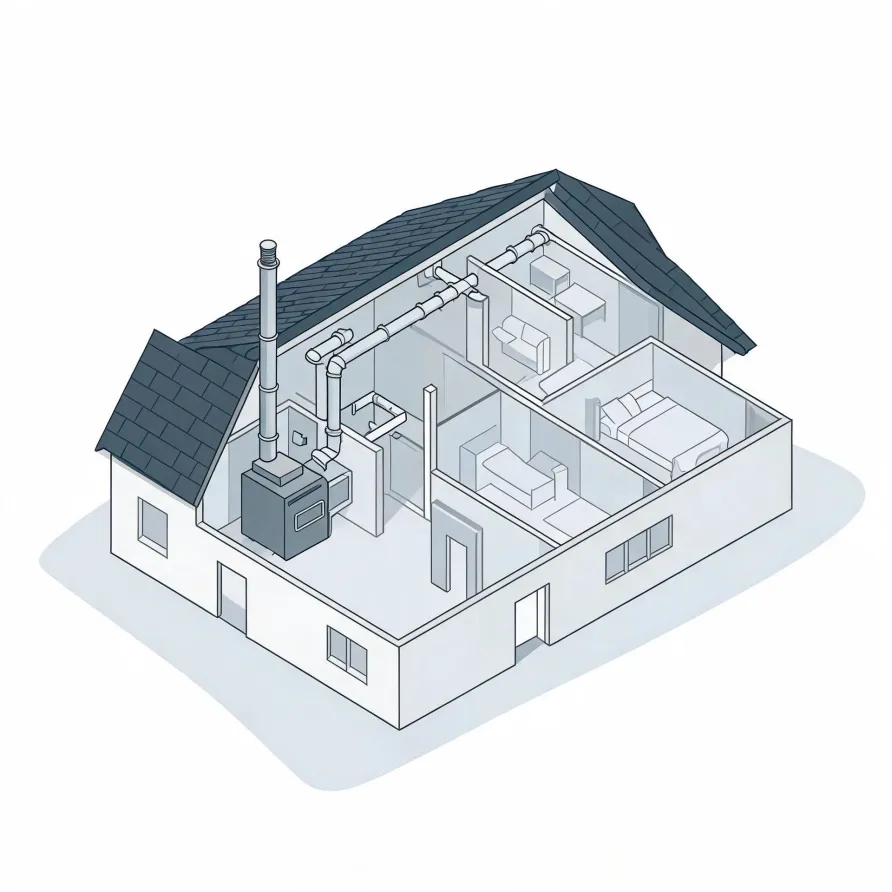
The furnace itself sits in the basement, utility room, or closet and is the heart of the repair call. Inside it, the heat exchanger transfers combustion heat to the air moving through your home, and a cracked or corroded exchanger is one of the first things a contractor will look for. The burners, which ignite the fuel, and the blower motor, which pushes conditioned air outward, are the other components that draw early attention.
The flue or vent pipe runs from the furnace to the outside of the house and carries combustion gases out safely. Alongside the furnace sits the air handler side of the system, where the filter rack and the blower compartment live. The thermostat on your wall ties it all together, sending the signal that starts and stops the whole sequence.
The drawing shows a general layout of these components, and a licensed contractor determines what applies to the specific equipment and configuration in your house.
Get matched in Erie CountyErie County, by the numbers
329 severe weather events were recorded in Erie County, New York between 2015 and 2024.
NOAA National Centers for Environmental Information, Storm Events Database, bulk CSV export, events 2015-01-01 through 2024-12-31.Half the homes in Erie County, New York were built in 1957 or earlier (2020-2024 ACS 5-year).
U.S. Census Bureau, 2020-2024 American Community Survey 5-Year EstimatesErie County, New York holds 441,214 housing units (2020-2024 ACS 5-year).
U.S. Census Bureau, 2020-2024 American Community Survey 5-Year EstimatesOwners occupy 65.8% of the occupied homes in Erie County, New York (2020-2024 ACS 5-year).
U.S. Census Bureau, 2020-2024 American Community Survey 5-Year EstimatesFurnace & HVAC Repair Rules on the Books for Erie County, New York4 sourced standards & codes
What HVAC Repair Looks Like in Erie County
Non-weatherized gas furnaces manufactured on or after November 19, 2015 must reach 80.0 percent AFUE.
Non-weatherized oil-fired furnaces manufactured on or after November 19, 2015 must reach 83.0 percent AFUE.
Mobile home gas furnaces manufactured on or after November 19, 2015 must reach 80.0 percent AFUE.
Non-weatherized gas furnaces manufactured on or after December 18, 2028 must reach 95.0 percent AFUE, up from the 80.0 percent minimum that applies to units manufactured before that date.
Severe Weather Events in Erie County
Harsh weather puts real hours on heating equipment. Furnaces that carry the load through difficult winters wear faster, and when something fails, the repair belongs to someone who knows this county's conditions.
329 severe weather events, 2015–2024. Source: NOAA National Centers for Environmental Information, Storm Events Database.