Tell us about the job
Takes about a minute. No obligation.
A furnace repair in Cortland County starts with what the burner and heat exchanger have already been through. Homes in Cortland County, NY run heat about nine months a year, from September through May. That kind of continuous cycling loads the ignition system, the heat exchanger, and the burner assembly in ways that accumulate across years. A crack in the heat exchanger or a failing ignitor is often what sends a furnace into lockout, and a contractor working a repair here checks those components before pricing the part a homeowner already suspects.
Furnaces running in Cortland County's older housing sit inside envelopes that were built for different combustion equipment entirely, which shapes what a contractor finds once the cabinet is open. Half the homes in Cortland County, New York were built in 1961 or earlier (2020-2024 ACS 5-year). That gap between the building and the system now in it means heat exchangers in this stock have been working against original airflow geometry, not the geometry the manufacturer specified. Cracks, warped burner assemblies, and stress fractures at the plenum connections are what a contractor actually looks for here, and parts availability for the equipment those houses ended up with is a real constraint on the repair scope.
The Parts of a Furnace a Contractor Checks First
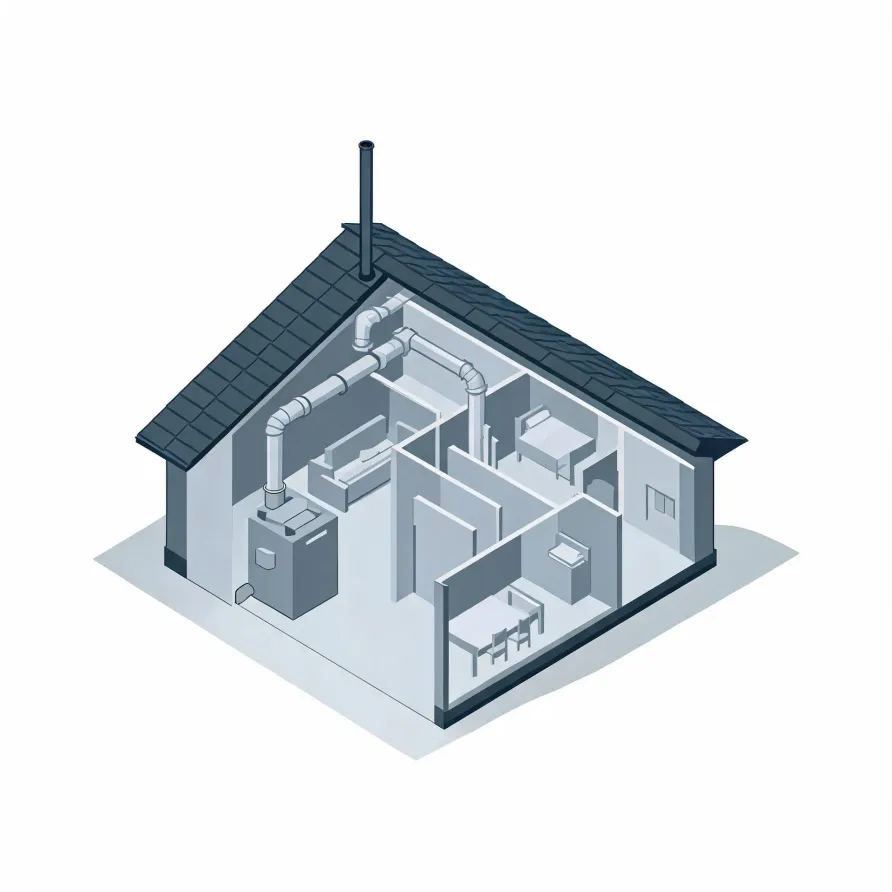
The furnace cabinet sits in a basement, utility closet, or crawlspace and is where a contractor starts. Inside it, the heat exchanger is the piece most worth attention: cracks or warping there are what bring a furnace to a stop, or worse. The burner assembly sits just below it, and a fault there shows up as ignition failure or uneven heat.
The blower motor sits at the base of the cabinet and pushes conditioned air into the supply plenum, which connects the furnace to the rest of the distribution system. The flue pipe runs from the cabinet up and out of the house, and a blockage or breach there is a repair that cannot wait. The thermostat, mounted on a wall in the living space, is where erratic behavior often points a contractor before they open the cabinet at all.
The drawing shows the general layout of a furnace system, and a licensed contractor determines what applies to the specific equipment and configuration in your house.
Get matched in Cortland CountyCortland County, by the numbers
156 severe weather events were recorded in Cortland County, New York between 2015 and 2024.
NOAA National Centers for Environmental Information, Storm Events Database, bulk CSV export, events 2015-01-01 through 2024-12-31.Half the homes in Cortland County, New York were built in 1961 or earlier (2020-2024 ACS 5-year).
U.S. Census Bureau, 2020-2024 American Community Survey 5-Year EstimatesCortland County, New York holds 20,841 housing units (2020-2024 ACS 5-year).
U.S. Census Bureau, 2020-2024 American Community Survey 5-Year EstimatesOwners occupy 66.3% of the occupied homes in Cortland County, New York (2020-2024 ACS 5-year).
U.S. Census Bureau, 2020-2024 American Community Survey 5-Year EstimatesCodes & Standards Governing Furnace Repair in Cortland County, New York4 sourced rules and standards
What HVAC Repair Looks Like in Cortland County
Non-weatherized gas furnaces manufactured on or after November 19, 2015 must reach 80.0 percent AFUE.
Non-weatherized oil-fired furnaces manufactured on or after November 19, 2015 must reach 83.0 percent AFUE.
Mobile home gas furnaces manufactured on or after November 19, 2015 must reach 80.0 percent AFUE.
Non-weatherized gas furnaces manufactured on or after December 18, 2028 must reach 95.0 percent AFUE, up from the 80.0 percent minimum that applies to units manufactured before that date.
Severe Weather Events in Cortland County
Extreme weather puts real hours on a furnace. When conditions outside push heating systems hard, wear accumulates faster and failures follow, which is why local weather patterns belong in any honest conversation about repair work in this area.
156 severe weather events, 2015–2024. Source: NOAA National Centers for Environmental Information, Storm Events Database.