Tell us about the job
Takes about a minute. No obligation.
A furnace repair here starts with a contractor accounting for what the equipment has already been through. Homes in Chautauqua County, NY run heat about eight months a year, from October through May. The burner, the heat exchanger, and the ignition system carry that load every cycle, and a furnace that has run through several of those seasons will show that history in cracked exchanger sections, worn igniters, and fatigued heat-side components before the cold-side ever becomes a concern. A contractor quoting a repair in this county looks at those parts first, because that is where the accumulated cycling shows up.
Furnaces installed in houses this old are rarely the first generation of replacement equipment in that space. Half the homes in Chautauqua County, New York were built in 1953 or earlier (2020-2024 ACS 5-year). What that means for repair work is that a contractor opening a furnace here is as likely to find previous field modifications, non-original flue routing, or burner components sourced from discontinued lines as they are to find a clean factory configuration. Parts availability becomes a real variable once a system has been adapted away from its original spec. The repair scope turns on what the opened unit actually contains, and that cannot be read from the outside.
The Parts of a Furnace a Contractor Checks First
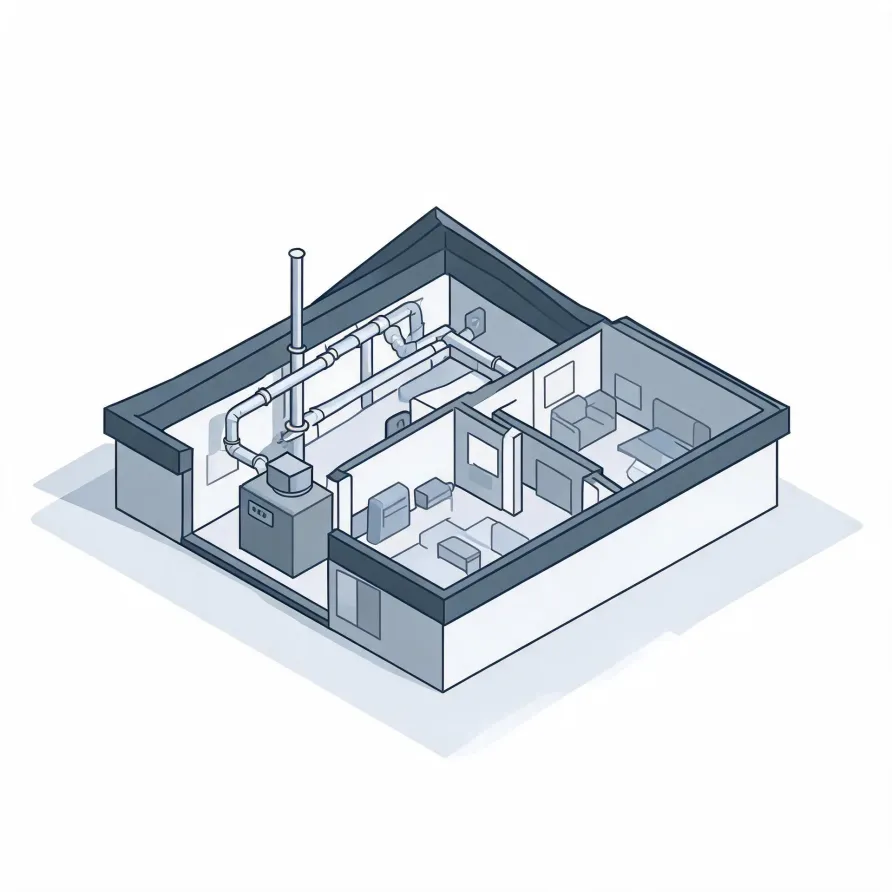
The heat exchanger sits at the core of the furnace cabinet, and it is the piece a contractor reaches first when something is wrong. Cracks or corrosion here affect both warmth and safety. The burner assembly sits just below it, and a dirty or misfiring burner is behind a large share of no-heat calls.
The blower motor and its fan wheel sit in the lower section of the cabinet and push conditioned air out into the house. The igniter and flame sensor are small parts, but either one failing will shut the furnace down entirely. The flue pipe runs from the cabinet up and out of the house, and a blocked or corroded flue shows up in diagnostic checks as well.
The drawing shows a typical furnace layout, and a licensed contractor will determine which components apply to the specific system and installation in your home.
Get matched in Chautauqua CountyChautauqua County, by the numbers
300 severe weather events were recorded in Chautauqua County, New York between 2015 and 2024.
NOAA National Centers for Environmental Information, Storm Events Database, bulk CSV export, events 2015-01-01 through 2024-12-31.Half the homes in Chautauqua County, New York were built in 1953 or earlier (2020-2024 ACS 5-year).
U.S. Census Bureau, 2020-2024 American Community Survey 5-Year EstimatesChautauqua County, New York holds 66,476 housing units (2020-2024 ACS 5-year).
U.S. Census Bureau, 2020-2024 American Community Survey 5-Year EstimatesOwners occupy 68.9% of the occupied homes in Chautauqua County, New York (2020-2024 ACS 5-year).
U.S. Census Bureau, 2020-2024 American Community Survey 5-Year EstimatesCodes & Standards for Furnace Repair in Chautauqua County, New York4 sourced rules & standards
What HVAC Repair Looks Like in Chautauqua County
Non-weatherized gas furnaces manufactured on or after November 19, 2015 must reach 80.0 percent AFUE.
Non-weatherized oil-fired furnaces manufactured on or after November 19, 2015 must reach 83.0 percent AFUE.
Mobile home gas furnaces manufactured on or after November 19, 2015 must reach 80.0 percent AFUE.
Non-weatherized gas furnaces manufactured on or after December 18, 2028 must reach 95.0 percent AFUE, up from the 80.0 percent minimum that applies to units manufactured before that date.
Severe Weather Events in Chautauqua County
Hard weather puts hours on a furnace fast, cycling it through demands it was not built to handle alone. How often that happens here shapes how much repair work the equipment in this area actually needs.
300 severe weather events, 2015–2024. Source: NOAA National Centers for Environmental Information, Storm Events Database.