Tell us about the job
Takes about a minute. No obligation.
A furnace repair in Lewis County starts with the parts that have worked the hardest. Homes in Lewis County, NY run heat about nine months a year, from September through May. The burner, the igniter, and the heat exchanger cycle on and off through that stretch, and those are the components a contractor checks first when something fails. Cracks in the heat exchanger or a worn igniter are not random findings here; they reflect what the equipment has actually been asked to carry. A system that has been undersized or installed with shortcuts shows the strain in those same spots.
Furnaces in houses this old have usually been replaced at least once since the house was built, and the replacement was fitted around whatever the existing flue and utility connections allowed. Half the homes in Lewis County, New York were built in 1972 or earlier (2020-2024 ACS 5-year). That history matters for repair work because the unit running in a house today is often a generation behind current production, which means parts availability is the variable a contractor checks before estimating anything. If a heat exchanger or a control board is no longer manufactured, a repair quote becomes a replacement conversation instead.
The Parts of a Furnace a Contractor Checks First
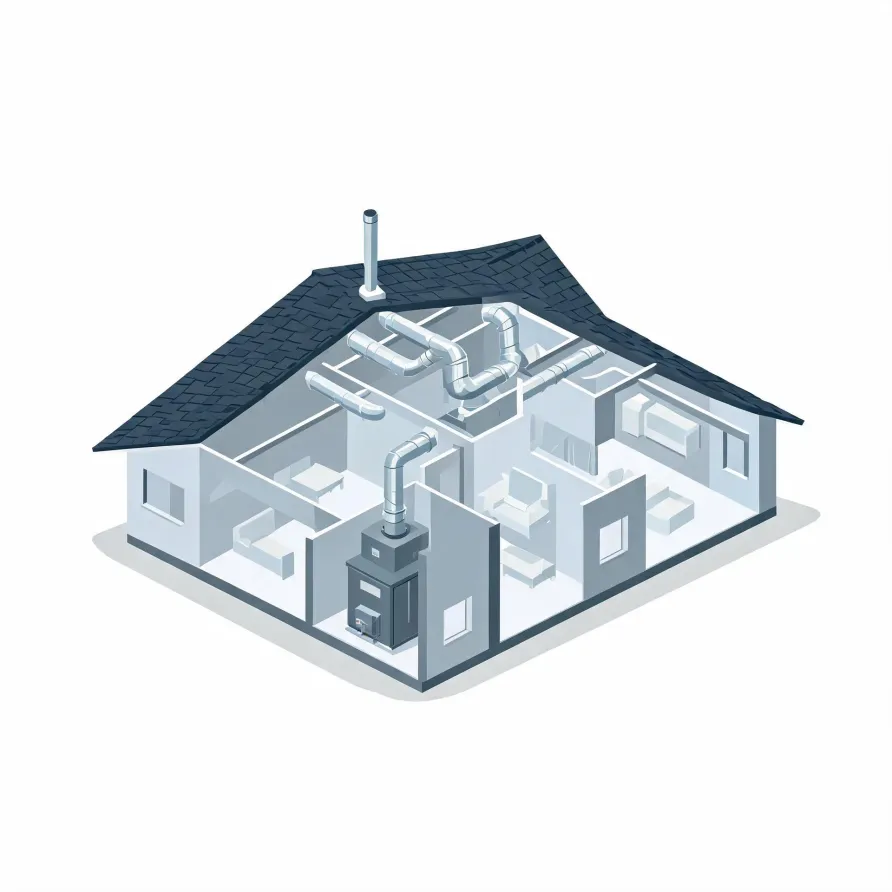
The furnace cabinet sits in the basement, utility closet, or mechanical room and is where most repair work begins. Inside it, the heat exchanger is the piece a contractor looks at closely: cracks or corrosion there let combustion gases into the living space. The burners, which sit just below it, are another early stop when the system fails to heat properly or short-cycles.
The blower motor and fan assembly sit at the base of the cabinet and push conditioned air into the duct system. The control board, flue pipe, and igniter are also inside or attached to the cabinet, and any one of them can be the source of a no-heat call. The thermostat on the wall is the last piece a contractor checks when the problem points to faulty signaling rather than a mechanical failure.
The drawing shows a typical furnace layout, and a licensed contractor determines exactly which parts apply to the system in your home.
Get matched in Lewis CountyLewis County, NY, by the numbers
192 severe weather events were recorded in Lewis County, New York between 2015 and 2024.
NOAA National Centers for Environmental Information, Storm Events Database, bulk CSV export, events 2015-01-01 through 2024-12-31.Half the homes in Lewis County, New York were built in 1972 or earlier (2020-2024 ACS 5-year).
U.S. Census Bureau, 2020-2024 American Community Survey 5-Year EstimatesLewis County, New York holds 15,637 housing units (2020-2024 ACS 5-year).
U.S. Census Bureau, 2020-2024 American Community Survey 5-Year EstimatesOwners occupy 80.2% of the occupied homes in Lewis County, New York (2020-2024 ACS 5-year).
U.S. Census Bureau, 2020-2024 American Community Survey 5-Year EstimatesCodes & Standards Governing Furnace Repair in Lewis County, New York4 sourced rules & standards
What HVAC Repair Looks Like in Lewis County
Non-weatherized gas furnaces manufactured on or after November 19, 2015 must reach 80.0 percent AFUE.
Non-weatherized oil-fired furnaces manufactured on or after November 19, 2015 must reach 83.0 percent AFUE.
Mobile home gas furnaces manufactured on or after November 19, 2015 must reach 80.0 percent AFUE.
Non-weatherized gas furnaces manufactured on or after December 18, 2028 must reach 95.0 percent AFUE, up from the 80.0 percent minimum that applies to units manufactured before that date.
Severe Weather Events in Lewis County
Hard weather puts real hours on heating equipment. Furnaces that cycle hard through weather stress show it in parts, controls, and heat exchangers, which is why local repair demand follows local conditions.
192 severe weather events, 2015–2024. Source: NOAA National Centers for Environmental Information, Storm Events Database.