Tell us about the job
Takes about a minute. No obligation.
A furnace that breaks in January has already been cycling hard since October, and a contractor tracing the fault starts with the parts that carry the thermal load: the heat exchanger, the burner assembly, and the ignition system. Homes in Orleans County, NY run heat about eight months a year, from October through May. That kind of cycling stresses metal through repeated expansion and contraction, and cracks in a heat exchanger or a worn igniter typically surface after the season's hardest stretches, not during them. When a contractor opens the unit, the condition of those components tells them whether this is a one-part repair or the beginning of a longer conversation about the system.
Ductwork and panels from when much of this county's housing went up were sized and routed for systems that no longer exist. Half the homes in Orleans County, New York were built in 1955 or earlier (2020-2024 ACS 5-year). A furnace running in a house that old has likely been replaced at least once, but the heat exchangers, gas valves, and limit switches a contractor pulls out today may belong to a generation of equipment that manufacturers have stopped supporting with parts. That is where the repair decision actually lands: whether what the opened furnace needs can still be sourced, and at what cost relative to the unit itself.
The Parts of a Furnace a Contractor Checks First
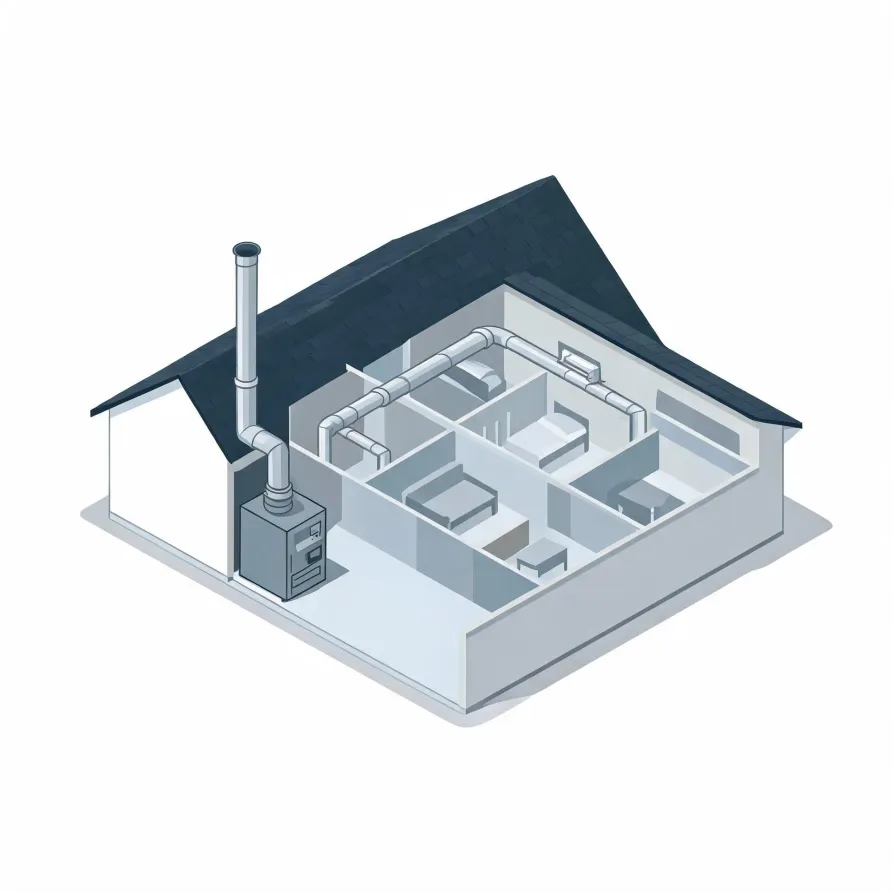
The furnace itself sits in a basement, utility room, or closet and is the piece a contractor goes to first. Inside it, the heat exchanger is the part that fails quietly but seriously: cracks in it let combustion gases mix with the air your home breathes. The burners, which fire beneath the heat exchanger, are checked for uneven flame, corrosion, and buildup that throws off combustion.
The blower motor sits at the base of the furnace cabinet and pushes conditioned air into the duct system. Alongside it, the inducer motor, the flame sensor, the igniter, and the control board each play a role in starting and sustaining a heating cycle. When any one of them fails, the furnace either does not start, shuts off before the cycle finishes, or runs without producing heat.
The drawing shows a typical furnace layout, and a licensed contractor determines which components apply to the specific unit and configuration in your home.
Get matched in Orleans CountyOrleans County, by the numbers
80 severe weather events were recorded in Orleans County, New York between 2015 and 2024.
NOAA National Centers for Environmental Information, Storm Events Database, bulk CSV export, events 2015-01-01 through 2024-12-31.Half the homes in Orleans County, New York were built in 1955 or earlier (2020-2024 ACS 5-year).
U.S. Census Bureau, 2020-2024 American Community Survey 5-Year EstimatesOrleans County, New York holds 18,326 housing units (2020-2024 ACS 5-year).
U.S. Census Bureau, 2020-2024 American Community Survey 5-Year EstimatesOwners occupy 77.2% of the occupied homes in Orleans County, New York (2020-2024 ACS 5-year).
U.S. Census Bureau, 2020-2024 American Community Survey 5-Year EstimatesCodes & Standards Governing Furnace Repair in Orleans County, New York4 sourced rules & standards
What HVAC Repair Looks Like in Orleans County
Non-weatherized gas furnaces manufactured on or after November 19, 2015 must reach 80.0 percent AFUE.
Non-weatherized oil-fired furnaces manufactured on or after November 19, 2015 must reach 83.0 percent AFUE.
Mobile home gas furnaces manufactured on or after November 19, 2015 must reach 80.0 percent AFUE.
Non-weatherized gas furnaces manufactured on or after December 18, 2028 must reach 95.0 percent AFUE, up from the 80.0 percent minimum that applies to units manufactured before that date.
Weather Stress on Heating Systems in Orleans County
Harsh weather puts direct strain on furnaces, forcing them to run harder and longer than manufacturers design for in mild conditions. That workload accumulates, and when something gives, the repair call is local.
80 severe weather events, 2015–2024. Source: NOAA National Centers for Environmental Information, Storm Events Database.