Tell us about the job
Takes about a minute. No obligation.
Homes in Niagara County, NY run heat about eight months a year, from October through May. That load falls entirely on the burner, the ignition system, and the heat exchanger, which cycle through every call for heat across a long working season before going idle in summer. A contractor diagnosing a furnace repair here checks those parts first, because they accumulate the most wear and are the likeliest source of a fault. Cracks in a heat exchanger or a failing igniter rarely announce themselves early; they show up when the system is already deep into a run.
Ductwork fitted for a furnace that is no longer in the house carries the history of every system that ran through it since. Half the homes in Niagara County, New York were built in 1958 or earlier (2020-2024 ACS 5-year). That age of duct shows up in a repair call as restricted airflow, cracked flex connections, or heat loss that the furnace itself is blamed for until a contractor opens the right panels. A furnace drawing hard against undersized or deteriorated duct will cycle short, run long, or trip a limit switch, and each symptom points toward equipment until the ductwork is actually measured.
The Parts of a Furnace a Contractor Checks First
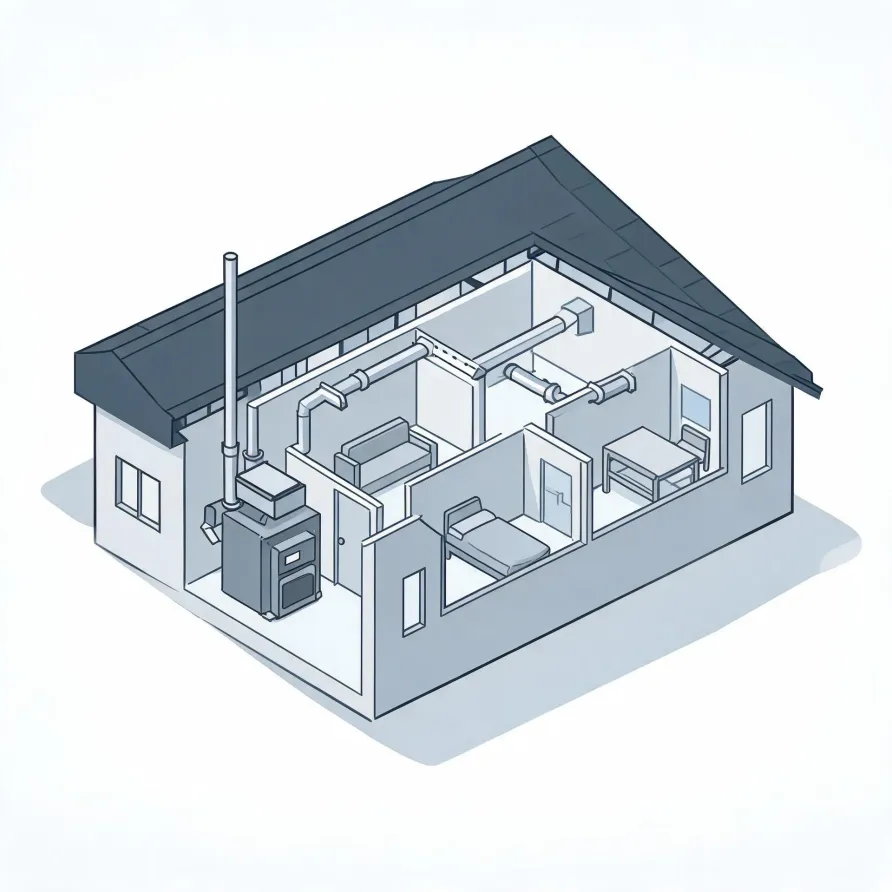
The furnace itself sits in the basement, utility room, or a dedicated closet and is the system's heat source. Inside it, the heat exchanger is the part a contractor looks at closely during a repair call, because a crack or failure there changes what the unit can safely do. The burners, which fire inside the heat exchanger, are another early stop when the system is producing too little heat or cycling off unexpectedly.
The blower motor sits at the base of the furnace cabinet and pushes conditioned air out into the house. Near it, the draft inducer pulls combustion gases out through the flue. The control board and the igniter are smaller components, but either one can stop the whole system cold when it fails.
The drawing shows a general layout of these components, and a licensed contractor determines exactly what applies in your home.
Get matched in Niagara CountyNiagara County, by the numbers
121 severe weather events were recorded in Niagara County, New York between 2015 and 2024.
NOAA National Centers for Environmental Information, Storm Events Database, bulk CSV export, events 2015-01-01 through 2024-12-31.Half the homes in Niagara County, New York were built in 1958 or earlier (2020-2024 ACS 5-year).
U.S. Census Bureau, 2020-2024 American Community Survey 5-Year EstimatesNiagara County, New York holds 100,446 housing units (2020-2024 ACS 5-year).
U.S. Census Bureau, 2020-2024 American Community Survey 5-Year EstimatesOwners occupy 71.2% of the occupied homes in Niagara County, New York (2020-2024 ACS 5-year).
U.S. Census Bureau, 2020-2024 American Community Survey 5-Year EstimatesFurnace Repair Rules & Codes for Niagara County, New York4 sourced rules and standards
What HVAC Repair Looks Like in Niagara County
Non-weatherized gas furnaces manufactured on or after November 19, 2015 must reach 80.0 percent AFUE.
Non-weatherized oil-fired furnaces manufactured on or after November 19, 2015 must reach 83.0 percent AFUE.
Mobile home gas furnaces manufactured on or after November 19, 2015 must reach 80.0 percent AFUE.
Non-weatherized gas furnaces manufactured on or after December 18, 2028 must reach 95.0 percent AFUE, up from the 80.0 percent minimum that applies to units manufactured before that date.
Severe Weather Events in Niagara County
Extreme weather puts real strain on furnace systems, and Niagara County gets its share of hard conditions. A furnace that works through that kind of stress needs repair work matched to what the local climate actually demands.
121 severe weather events, 2015–2024. Source: NOAA National Centers for Environmental Information, Storm Events Database.