Tell us about the job
Takes about a minute. No obligation.
Homes in Clinton County, NY run heat about nine months a year, from September through May. A furnace cycling through a season that long puts its heaviest load on the heat exchanger and burner assembly. Cracks in the heat exchanger and igniter degradation are the failures a contractor finds most often here, because those are the parts that cycle every time the thermostat calls for heat. Controls and secondary components can wait in the queue; the combustion side gets checked first.
Ductwork in a house this old has been through enough heating seasons that a contractor opening a furnace here checks the distribution system as carefully as the unit itself. Cracks at the heat exchanger, deteriorated flue connections, and sections of duct that have shifted or sealed poorly over time are what slow a repair down and change its scope. Half the homes in Clinton County, New York were built in 1974 or earlier (2020-2024 ACS 5-year). That timeline means the furnace a contractor is working on was almost certainly installed into a house that was already decades old, and the surrounding infrastructure reflects that. A flue liner sized for a different appliance, or duct joints that were sealed with materials no longer holding, can turn a straightforward parts repair into a broader job.
The Parts of a Furnace a Contractor Checks First
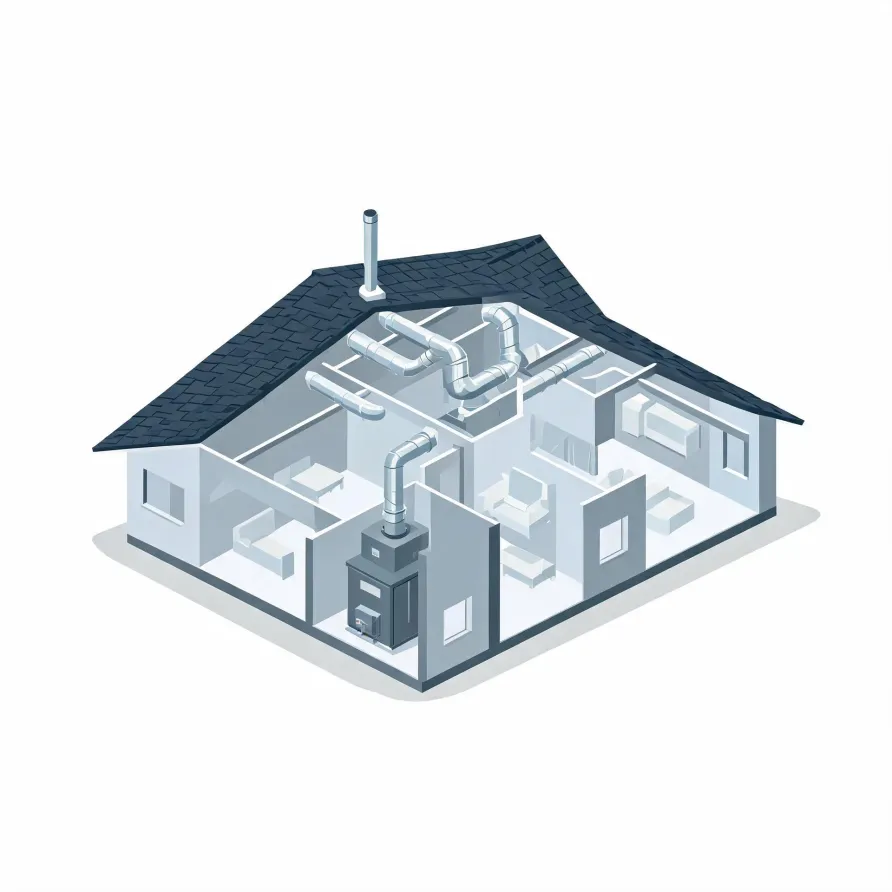
The furnace itself sits in the basement, utility room, or closet and is the heart of the system. Inside it, the heat exchanger is the piece a contractor looks at closely during a repair call. Cracks or failures there affect both heat output and safety, making it one of the first components a technician traces when something is wrong.
The blower motor and its fan sit inside the furnace cabinet and push conditioned air into the supply ducts. The burner assembly and igniter sit at the base of the heat exchanger, and the flue or exhaust vent runs from the unit up and out of the house. The thermostat on your wall is the control point, and a fault anywhere in that chain can show up as a symptom at any of the others.
The drawing shows a typical furnace layout, and a licensed contractor determines which components apply and what work is needed in your specific home.
Get matched in Clinton CountyClinton County, by the numbers
133 severe weather events were recorded in Clinton County, New York between 2015 and 2024.
NOAA National Centers for Environmental Information, Storm Events Database, bulk CSV export, events 2015-01-01 through 2024-12-31.Half the homes in Clinton County, New York were built in 1974 or earlier (2020-2024 ACS 5-year).
U.S. Census Bureau, 2020-2024 American Community Survey 5-Year EstimatesClinton County, New York holds 37,658 housing units (2020-2024 ACS 5-year).
U.S. Census Bureau, 2020-2024 American Community Survey 5-Year EstimatesOwners occupy 69.4% of the occupied homes in Clinton County, New York (2020-2024 ACS 5-year).
U.S. Census Bureau, 2020-2024 American Community Survey 5-Year EstimatesCodes & Standards for Furnace Repair in Clinton County, New York4 sourced rules & standards
What HVAC Repair Looks Like in Clinton County
Non-weatherized gas furnaces manufactured on or after November 19, 2015 must reach 80.0 percent AFUE.
Non-weatherized oil-fired furnaces manufactured on or after November 19, 2015 must reach 83.0 percent AFUE.
Mobile home gas furnaces manufactured on or after November 19, 2015 must reach 80.0 percent AFUE.
Non-weatherized gas furnaces manufactured on or after December 18, 2028 must reach 95.0 percent AFUE, up from the 80.0 percent minimum that applies to units manufactured before that date.
Weather Load in Clinton County
Heating equipment in this part of New York works against whatever the climate throws at it, and that workload compounds over time. How hard a furnace has been pushed is a local question, and the record of severe weather events here is part of that answer.
133 severe weather events, 2015–2024. Source: NOAA National Centers for Environmental Information, Storm Events Database.