Tell us about the job
Takes about a minute. No obligation.
A furnace repair quote in Hamilton County starts with the parts that have worked the hardest. Homes in Hamilton County, NY run heat about ten months a year, from September through June. The burner, the ignition system, and the heat exchanger cycle on and off through most of that span, and wear on those components is what a contractor finds first when something fails. Cracks in a heat exchanger or a degraded igniter are not surprises here. A contractor who skips straight to the control board before checking those parts is working in the wrong order.
Furnace parts ordered for a Hamilton County house arrive from a catalog built around equipment generations newer than much of what a contractor pulls open here. Half the homes in Hamilton County, New York were built in 1969 or earlier (2020-2024 ACS 5-year). That gap matters at the repair bench: heat exchangers, burner assemblies, and ignition components in this stock have run through conditions that push them past the tolerances their replacements are rated for, and the parts a contractor needs are sometimes no longer manufactured to the same spec. What the opened furnace contains decides the repair, and in stock this old, what it contains is frequently a surprise.
The Parts of a Furnace a Contractor Checks First
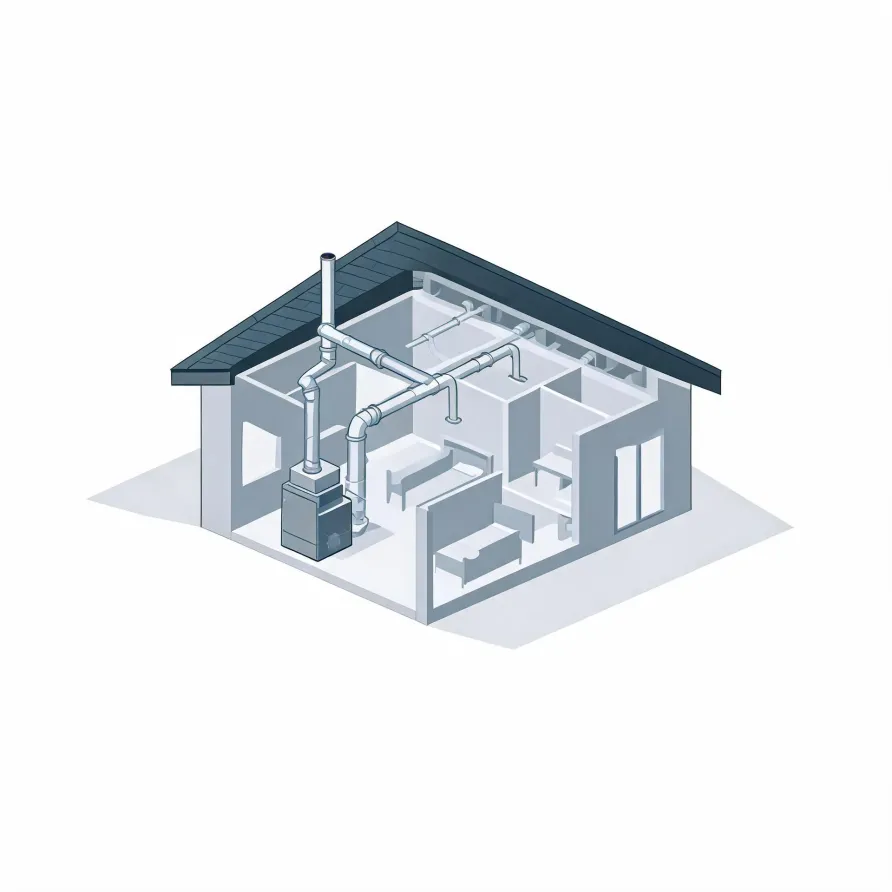
The furnace itself sits in a basement, utility closet, or mechanical room and is the piece a contractor goes to first. Inside it, the heat exchanger is the part most worth understanding: it carries combustion gases away from the living space while warming the air that circulates through the house. A cracked heat exchanger is a repair that shows up with no warning and no obvious symptom until a contractor looks for it.
The burner assembly and igniter sit inside the furnace cabinet and work together to start and sustain combustion. The blower motor sits just below or beside the heat exchanger and pushes conditioned air out through the supply side. The flue pipe runs from the cabinet to an exterior vent and is the piece a contractor checks when combustion looks off or the unit is shutting itself down.
The drawing shows a typical furnace layout, and a licensed contractor determines which parts apply to the specific system and installation in your home.
Get matched in Hamilton CountyHamilton County, NY, by the numbers
105 severe weather events were recorded in Hamilton County, New York between 2015 and 2024.
NOAA National Centers for Environmental Information, Storm Events Database, bulk CSV export, events 2015-01-01 through 2024-12-31.Half the homes in Hamilton County, New York were built in 1969 or earlier (2020-2024 ACS 5-year).
U.S. Census Bureau, 2020-2024 American Community Survey 5-Year EstimatesHamilton County, New York holds 7,911 housing units (2020-2024 ACS 5-year).
U.S. Census Bureau, 2020-2024 American Community Survey 5-Year EstimatesOwners occupy 82.4% of the occupied homes in Hamilton County, New York (2020-2024 ACS 5-year).
U.S. Census Bureau, 2020-2024 American Community Survey 5-Year EstimatesFurnace Repair Rules & Codes for Hamilton County, New York4 sourced standards and regulations
What HVAC Repair Looks Like in Hamilton County
Non-weatherized gas furnaces manufactured on or after November 19, 2015 must reach 80.0 percent AFUE.
Non-weatherized oil-fired furnaces manufactured on or after November 19, 2015 must reach 83.0 percent AFUE.
Mobile home gas furnaces manufactured on or after November 19, 2015 must reach 80.0 percent AFUE.
Non-weatherized gas furnaces manufactured on or after December 18, 2028 must reach 95.0 percent AFUE, up from the 80.0 percent minimum that applies to units manufactured before that date.
Severe Weather Events in Hamilton County
Heating equipment in Hamilton County works against whatever the local climate throws at it, and storm activity is part of that load. How hard a furnace runs, and how often it needs attention, is shaped by local conditions.
105 severe weather events, 2015–2024. Source: NOAA National Centers for Environmental Information, Storm Events Database.