Tell us about the job
Takes about a minute. No obligation.
A furnace in Jefferson County runs its burner, heat exchanger, and ignition system hard before spring arrives. Homes in Jefferson County, NY run heat about nine months a year, from September through May. That kind of continuous cycling wears the igniter and flame sensor well ahead of other components, and a contractor diagnosing a breakdown here checks those parts before looking elsewhere. A system that was marginal at installation shows those faults sooner, because the season leaves little slack for a component that is already tired.
Furnaces that have run through this many heating seasons leave specific evidence once a contractor opens them: heat exchanger fatigue, corroded burner assemblies, and controls from product lines that have since been discontinued. Whether a replacement part is still manufactured is the question that decides how a repair job resolves, and in a county where the housing stock runs this old, that question comes up often. Half the homes in Jefferson County, New York were built in 1972 or earlier (2020-2024 ACS 5-year). A furnace still running in a house that age was likely retrofitted at some point, which means the contractor may be opening a system that does not match the original installation drawings. Parts availability, not diagnostic complexity, is where Jefferson County furnace repairs tend to stall.
The Parts of a Furnace a Contractor Checks First
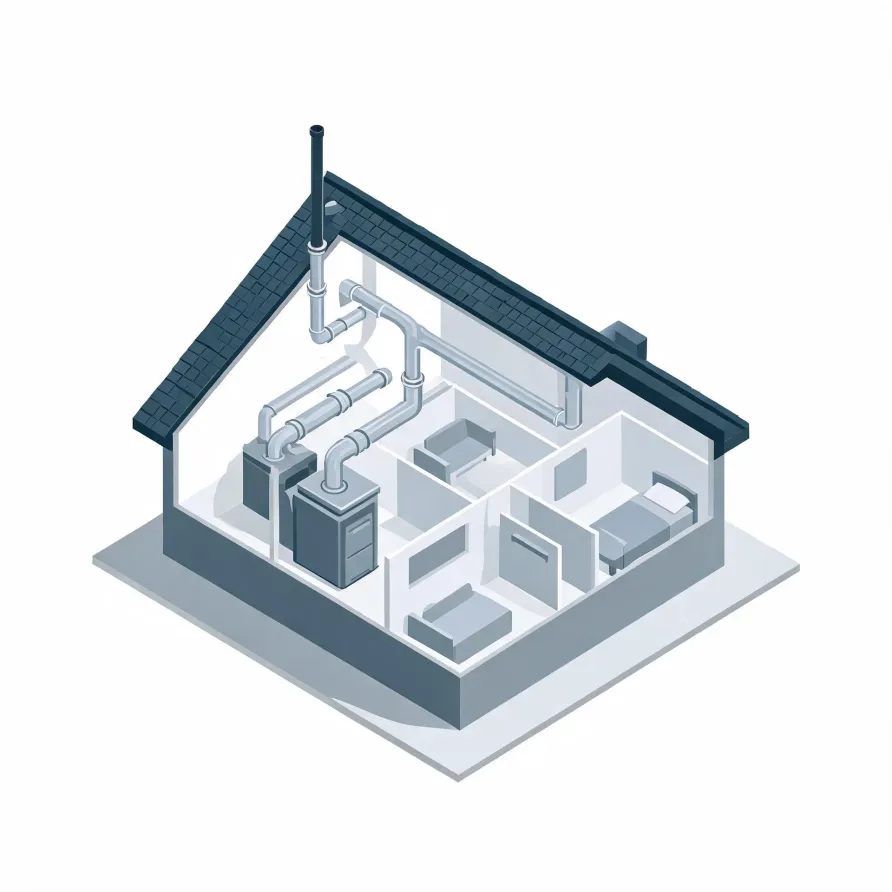
The furnace itself sits in a basement, utility closet, or mechanical room and is the piece a contractor goes to first. Inside it, the heat exchanger is the part that does the central work, and a crack or failure there is one of the more serious findings a repair visit can turn up. The burners, which fire inside that exchanger, are another early stop.
The blower motor sits at the base of the furnace cabinet and pushes conditioned air out through the house. Alongside it, the control board coordinates every other component, and a fault there can produce symptoms that look like several different failures at once. The flue pipe runs from the cabinet to an outside vent and gets checked for blockage or damage on the same visit.
The drawing shows a typical furnace layout, and a licensed contractor determines which parts apply and what condition they are in for your specific home.
Get matched in Jefferson CountyJefferson County, by the numbers
163 severe weather events were recorded in Jefferson County, New York between 2015 and 2024.
NOAA National Centers for Environmental Information, Storm Events Database, bulk CSV export, events 2015-01-01 through 2024-12-31.Half the homes in Jefferson County, New York were built in 1972 or earlier (2020-2024 ACS 5-year).
U.S. Census Bureau, 2020-2024 American Community Survey 5-Year EstimatesJefferson County, New York holds 61,862 housing units (2020-2024 ACS 5-year).
U.S. Census Bureau, 2020-2024 American Community Survey 5-Year EstimatesOwners occupy 54.7% of the occupied homes in Jefferson County, New York (2020-2024 ACS 5-year).
U.S. Census Bureau, 2020-2024 American Community Survey 5-Year EstimatesCodes & Standards Covering Furnace Repair in Jefferson County, New York4 sourced rules & standards
What HVAC Repair Looks Like in Jefferson County
Non-weatherized gas furnaces manufactured on or after November 19, 2015 must reach 80.0 percent AFUE.
Non-weatherized oil-fired furnaces manufactured on or after November 19, 2015 must reach 83.0 percent AFUE.
Mobile home gas furnaces manufactured on or after November 19, 2015 must reach 80.0 percent AFUE.
Non-weatherized gas furnaces manufactured on or after December 18, 2028 must reach 95.0 percent AFUE, up from the 80.0 percent minimum that applies to units manufactured before that date.
Weather Stress on HVAC Equipment in Jefferson County
Hard weather puts furnaces through cycles they were not built to sustain indefinitely. How often that happens here shapes how much repair work local equipment actually needs, which is why this data belongs on a page about Jefferson County furnace service.
163 severe weather events, 2015–2024. Source: NOAA National Centers for Environmental Information, Storm Events Database.