Tell us about the job
Takes about a minute. No obligation.
A furnace repair in Westchester starts with the parts that take the most punishment from repeated cycling: the heat exchanger, the burner assembly, and the ignition system. Homes in Westchester County, NY run heat about eight months a year, from October through May. Those components are doing meaningful work from the first cold week in October through late spring, and wear on them is not evenly distributed. The heat exchanger cracks from thermal stress; the igniter degrades from repeated firing. A contractor who goes straight to those parts on a Westchester furnace call is working from what the season has already done to the equipment.
Ductwork laid down for a coal or early oil furnace carries different proportions, different sealing standards, and different junction points than what a contractor opens today. Half the homes in Westchester County, New York were built in 1959 or earlier (2020-2024 ACS 5-year). That gap between the original build and the current equipment means a technician pulling a heat exchanger or a blower assembly here is as likely to find improvised transitions and worn seals at the trunk lines as anything wrong with the unit itself. Parts for the furnace may be straightforward to source; getting the repaired system to move heat the way it should through a distribution system it was never matched to is where the job gets complicated.
The Parts of a Furnace a Contractor Checks First
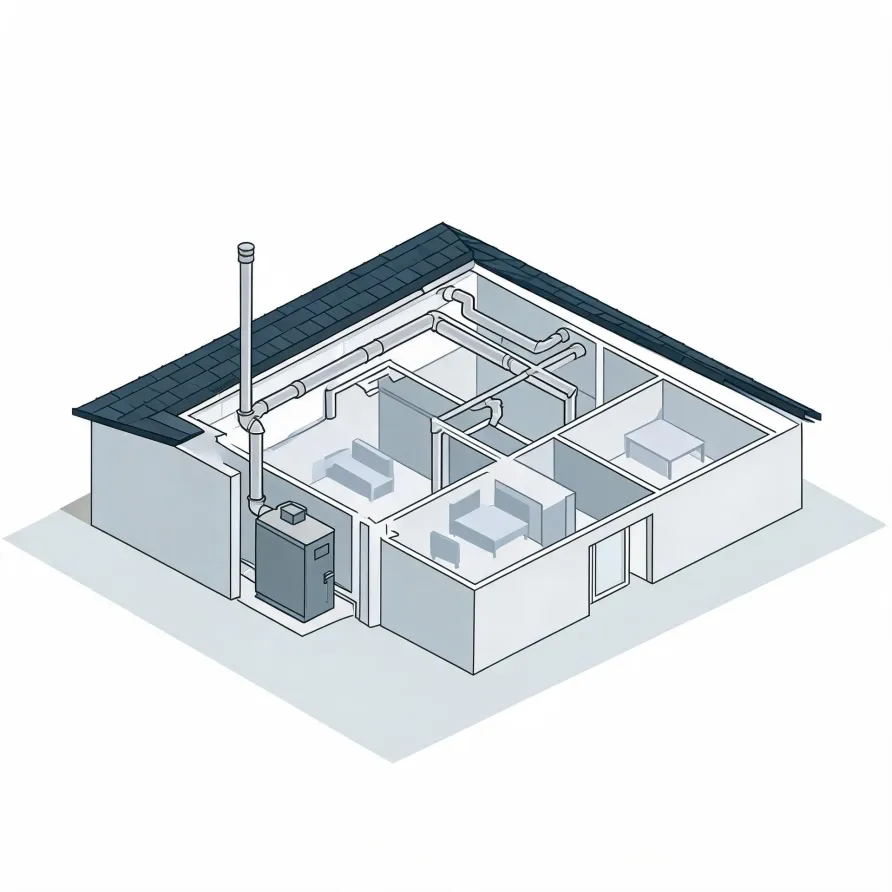
The furnace itself sits in a basement, utility closet, or mechanical room and is the piece a contractor goes to first. Inside it, the heat exchanger is the part that matters most when something has gone wrong: cracks or stress fractures there let combustion gases reach the living space, so a contractor looks at it closely before anything else. The burners, which sit directly below the exchanger, are an early suspect when the furnace fails to heat properly or ignites unevenly.
The blower motor sits at the base of the furnace cabinet and pushes conditioned air into the duct system. Alongside it, the control board reads signals from the thermostat and tells each component when to run. The flue pipe carries exhaust out of the house, and a contractor checks it for blockages or separation whenever the heat exchanger or burners show signs of trouble.
The drawing shows a typical furnace layout, and a licensed contractor determines which components apply to the specific system in your home.
Get matched in Westchester CountyWestchester County, by the numbers
229 severe weather events were recorded in Westchester County, New York between 2015 and 2024.
NOAA National Centers for Environmental Information, Storm Events Database, bulk CSV export, events 2015-01-01 through 2024-12-31.Half the homes in Westchester County, New York were built in 1959 or earlier (2020-2024 ACS 5-year).
U.S. Census Bureau, 2020-2024 American Community Survey 5-Year EstimatesWestchester County, New York holds 394,358 housing units (2020-2024 ACS 5-year).
U.S. Census Bureau, 2020-2024 American Community Survey 5-Year EstimatesOwners occupy 61.8% of the occupied homes in Westchester County, New York (2020-2024 ACS 5-year).
U.S. Census Bureau, 2020-2024 American Community Survey 5-Year EstimatesCodes & Standards Behind Furnace Repair in Westchester County, New York4 sourced rules and standards
What HVAC Repair Looks Like in Westchester County
Non-weatherized gas furnaces manufactured on or after November 19, 2015 must reach 80.0 percent AFUE.
Non-weatherized oil-fired furnaces manufactured on or after November 19, 2015 must reach 83.0 percent AFUE.
Mobile home gas furnaces manufactured on or after November 19, 2015 must reach 80.0 percent AFUE.
Non-weatherized gas furnaces manufactured on or after December 18, 2028 must reach 95.0 percent AFUE, up from the 80.0 percent minimum that applies to units manufactured before that date.
Severe Weather Events in Westchester County
Extreme weather puts real stress on furnace systems, and Westchester County has its own pattern of conditions that shape how hard local equipment has to work. That workload is a repair question as much as it is a weather question.
229 severe weather events, 2015–2024. Source: NOAA National Centers for Environmental Information, Storm Events Database.